

The Press Release is Dead? Think Again.
The rise of Gen AI is changing PR best practice. In this post you will learn why headlines must now be 76–100 characters, how to optimise your press releases for AI citation, and the key elements B2B communicators are prioritising in 2025. In short – everything you need to know about AI Press Release Optimisation.
For decades, experts have predicted the demise of the press release. However, the 2025 Global State of the Press Release Report reveals the opposite: the press release is not only alive, but with the advent of generative AI, it is cementing its status as an authoritative, reliable piece of content.
The disruptive power of Generative AI (Gen AI) has shifted how news is consumed. While traditional SEO (Search Engine Optimization) remains essential, communicators must now also focus on being the primary, cited source in AI overviews and featured snippets—a strategy we’ll call Answer Engine Optimization (AEO). The good news is that Gen AI can be your co-pilot in this evolution.
🤖 Generative AI: The New PR Co-Pilot
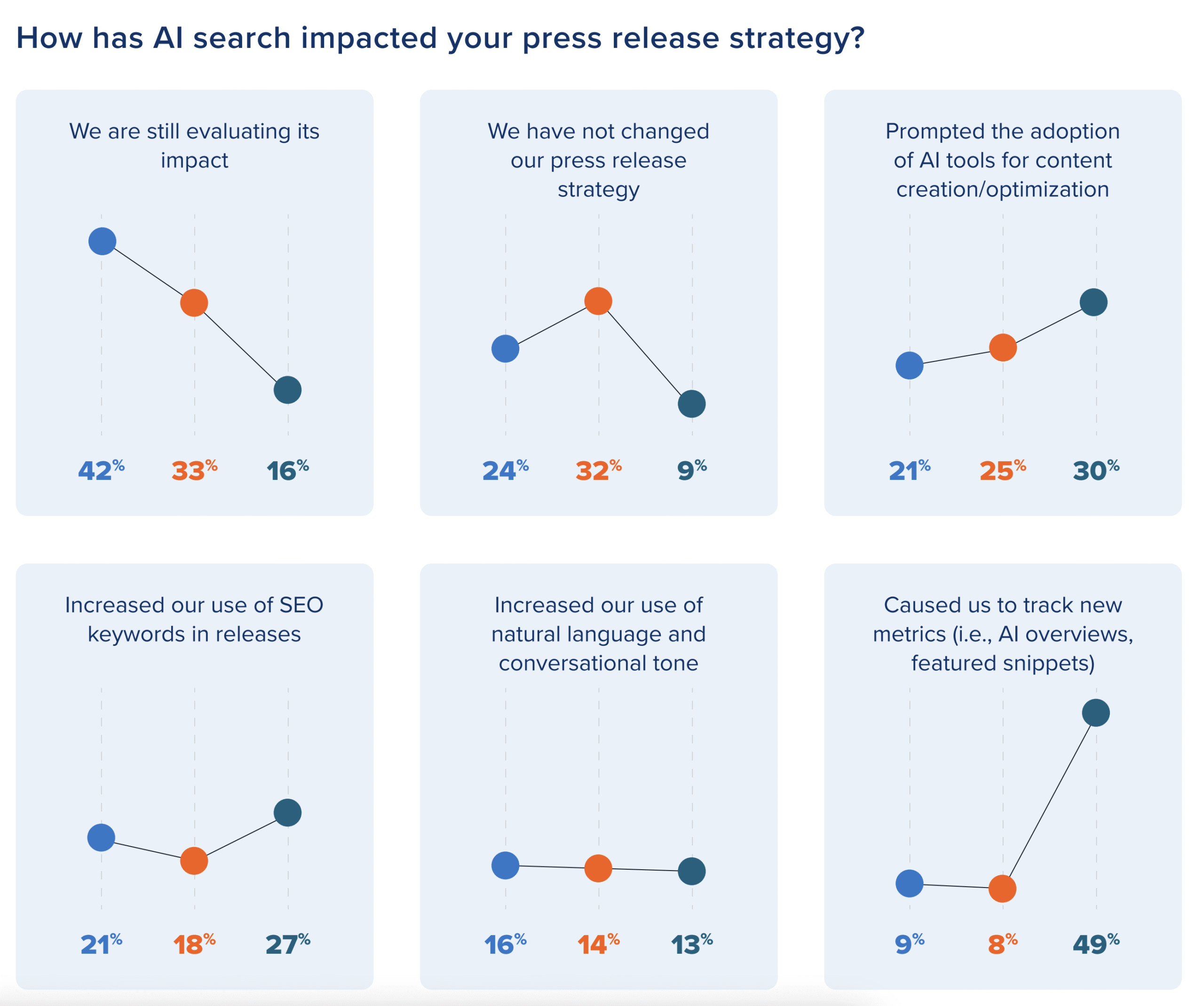
Gen AI tools are no longer optional—they are becoming crucial for strategic communicators. Globally, 57% of communicators are either currently using Gen AI to craft some aspect of their press release content or are open to using it in the future. Communicators in the Asia-Pacific (APAC) region are leading the charge, with 63% reporting that they use AI for this purpose.
This adoption is driven by a powerful toolkit of time-saving and quality-boosting applications:
- Content Generation: 38% of global communicators use AI for writing headlines, and $37% use it for writing body copy.
- Quality Control: 37% use AI for instant grammar, spelling, and proofreading.
- Strategic Optimisation: Communicators are also leveraging AI for high-value tasks such as SEO keyword suggestions, writing outlines or thought starters, consolidating a release to make it more concise, drafting quotes, and optimising the release specifically for LLMs.
📐 Formatting for the Answer Engine (AEO)
To maximize visibility and earn a citation in an AI summary, the structure of your press release must be optimized for machine-readability. Get these three components right for optimum AI press release optimisation.
The Headline Sweet Spot
For years, PR best practice dictated keeping headlines short (around 51–75 characters) to avoid being cut off in search results. However, the report shows a clear, AI-driven shift: the highest viewership is now for releases with headlines between 76 and 100 characters.
This change is directly tied to the rise of AEO. A slightly longer, more descriptive headline provides the Large Language Model (LLM) with “more keywords and context to analyze”. This context is vital for the AI to understand the news and use it as source material.
Crucially, while longer is now better, avoid going over 125 characters, which risks decreasing engagement.
Strategic Verb Selection
As AI consumes massive volumes of text, standing out visually becomes paramount. While “announce” and “launch” are the most commonly used verbs, communicators should use AI tools to brainstorm and integrate action verbs that “invoke intrigue,” such as “reveal” or “unveil.” These words garner a higher viewership rate relative to their use, cutting through the content clutter.
High-Impact Components
The report asked communicators to rank press release elements by their impact on success. The results show a focus on scannable, citable content:
- Headline
- Subheadline
- Executive Pull Quote
- Key Takeaways Section
The elevated ranking of the Key Takeaways Section clearly reflects communicators’ strategic intent to get cited by AI. For an AI to efficiently parse and summarize your news, you must use clear, descriptive language with short, scannable sentences and paragraphs.
🎬 Beyond Text: Creating Multimodal Assets with AI
Multimodal AI tools—like Google Gemini, ChatGPT, and Claude—can process not just text, but also images, videos, and audio. This makes multimedia a critical tool for providing these engines with comprehensive data.
- The Engagement Boost: Including multimedia has been shown to increase engagement and enable better memory recall of content.
- Video Repurposing: Over half (52%) of APAC communicators are repurposing press release content into video. Generative AI can assist by drafting video scripts or suggesting visual concepts directly from the text.
- The Logo: While multimedia elements (photos and video) were ranked lower in impact by PR practitioners. So, including your logo is vital. It signals the relevance of your press release to any brand-related AI searches and legitimises the story as one produced by a brand.
Conclusion: The Future is Optimised – Make Sure You Understand AI Press Release Optimisation
The top challenge cited by communicators is “Not generating anticipated media pickup” (33%). By leveraging Gen AI to optimize your content—using longer, descriptive headlines, structuring copy for citation, and creating multimodal assets—you can solve this problem.
The press release is resilient, but your strategy cannot be static. Embrace AI for optimisation, and your brand will control its narrative and achieve maximum visibility in the new era of the Answer Engine.
If you want to read the full report – CLICK HERE>>
***Bonus Tip***
If you need help with your messaging, why not try the Message Matrix that I describe in this article